

LinkedIn just published “LinkedIn Jobs on the Rise 2026: The 25 fastest-growing roles in the U.S.” AI related roles dominate the list to nobody’s surprise:
1. AI Engineers
2. AI Consultants & Strategists
4. Data Annotators (cleaning data for LLM input)
5. AI/ML Researchers
After lagging the broader trend for years, our practice is now seeing substantially more of these positions. AI Consultants and Strategists is an interesting category. Everybody now claims to be an expert despite the newness of the technology and the lack of clarity around how it will evolve and how to implement it with the technology evolving so rapidly. A friend of mine has been a language and systems guru for decades. Asked in a recent seminar on implementing AI in Java, “What are best practices?” His answer was simple, “There are none.”
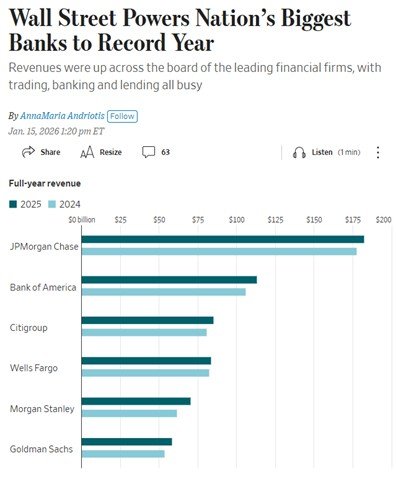
2025 was a great year for financial firms with trading, M&A, and lending all having great years. Stock prices are up, bonuses were good, and hiring is… tepid at best. Morgan Stanley just laid off 3% of its workforce, and Goldman Sachs is predicted to follow. That said, these firms are hiring, so perhaps the layoffs are just healthy culling and trimming those groups where AI is having an early impact. I have included the chart below many times in this report, as it's helpful to see the bank hiring trends at a macro level. The chart starts with Covid, ramps into the post Covid hiring boom, sharply dips after the boom, and then eases into The Malaise. Yes, I just coined that. Banks are keeping a tight rein on headcount and hoping to do more with technology (hint, AI).
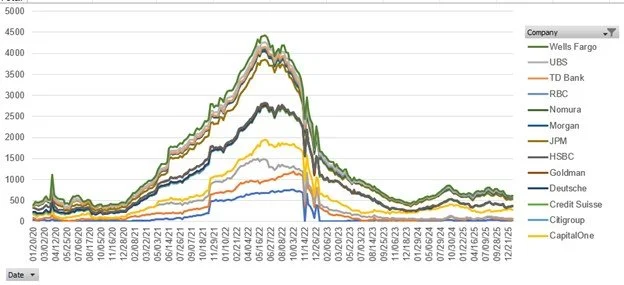
Number of Bank Job Openings New York Metro
Meanwhile, the Buy Side is also thriving, with net inflows positive in 2025 for the first time in several years. Per Goldman, “Hedge funds returned an average of 11.8% last year and 11.9% in 2024. They have now outperformed a traditional balanced 60/40 equity-bond portfolio every year since the Federal Reserve started raising rates in 2022.” Further, “Almost half of the allocators surveyed (49%) say they plan to increase their exposure to hedge funds this year, up from 37% a year earlier, and just 4% say they plan to decrease exposure.” Unlike at banks, these results and inflows have spurred hiring. We have a very healthy hiring pipeline among our hedge fund clients. Year over year, we see about 25% more job postings across our buy side clients. Current hiring is the most robust we’ve experienced since early 2022.
More broadly, Indeed job posting data is showing that demand for software engineers rose 11% year-over-year in early 2026.
Computer Science
If the current market for quants and software engineers is improving, what’s happening here: If you want to be unemployed when you graduate, study computer science:. “CS graduates from 2023 in the UK reported an average unemployment rate of 9.7%. This was, by some margin, the highest unemployment rate (by subject area).”
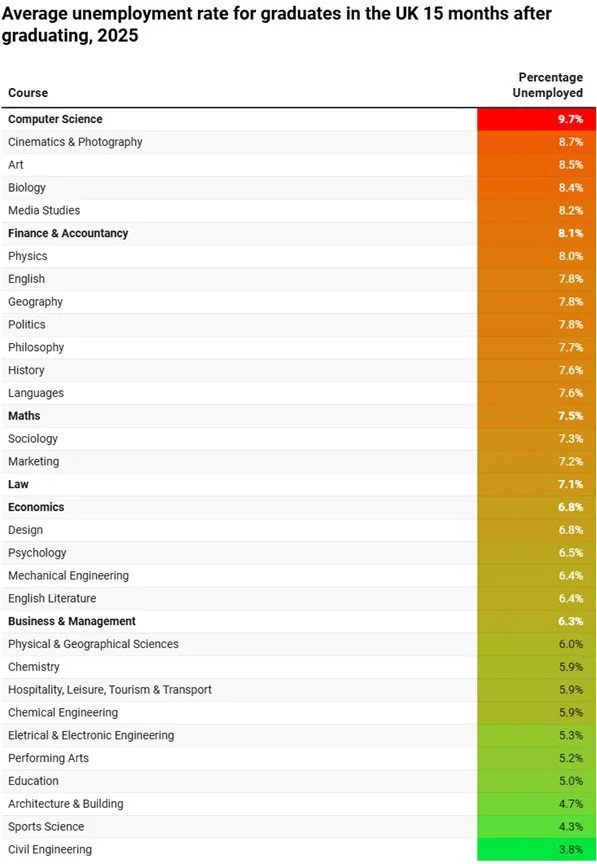
Is Computer Science really a rotten field now? Has AI already taken over? Clearly, not. The fact of the matter is that we’re graduating way more computer science grads in recent years, and in a slow job market, the percentages look unfavorable.
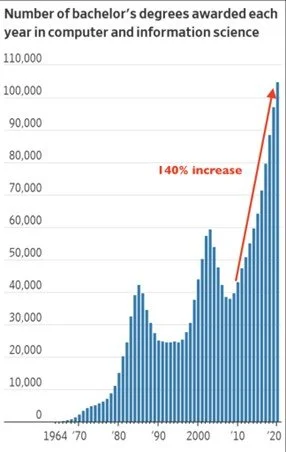
Decade-by-Decade Trends
1960s–1970s: Emergence as a distinct academic discipline, with graduates numbering in the low thousands.
1980s: Initial boom due to the personal computer explosion; peaked around 1986 with over 42,000 bachelor's degrees.
1990s: Decline after the 1980s peak, hitting a low of 24,553 in 1994, followed by a surge toward the end of the decade.
2000s: Peak in 2003 (57,926), followed by a sharp drop-off to roughly 28,000 by 2008-2009 after the dot-com bubble burst.
2010s–Present: A massive surge began post-2009, driven by mobile technology, data, and AI, surpassing the 2003 peak by 2015 and reaching 112,720 in the 2022-2023 academic year.
Recent Surge: As of 2023, computer science has shown the highest increase in bachelor's earners compared to other fields.
This growth has universities disgorging more graduates into a tepid hiring market owing to 1) uncertain economy 2) slow-down from pre and post-covid hiring binges, 3) AI Paralysis – not knowing how to move forward when the state of the art is shifting so rapidly.
Will AI Take Your Job?
Kyle Downey, VP of Product Strategy at Talus, and one of the smartest guys I know, wrote me last week: If you are a software developer and AI doesn't make you more, not less, valuable, you are doing something wrong.
Another senior technologist noted that AI shifts the focus more to developing core building blocks for AI to leverage. Taking it further, “Box CEO Aaron Levie advises developers to stop building software for humans and start building for the "trillions of agents" taking over enterprise work.
You won’t get paid for building basic websites anymore (I wrote my first web app yesterday with Claude Code in a few minutes – wow). But our practice has always been on hardcore engineering, and Herb Sutter predicts that’s not going away, quite the contrary.
Things are hard for graduates, however. A CTO of a $100M ARR startup reports zero junior hires since 2024, with senior employees now 3x more productive.
And if it wasn’t enough to try to comprehend where it’s all going, now there’s research that shows that overseeing your AI Agents leads to Brain Fry. This phenomenon feels like a confirmation of Jevon’s Paradox, but it doesn’t sound like AI is making your job easier…
The Innermost Loop is a brilliant blog from Alex Wissner-Gross that has become critical daily reading for me, if only to remind me how fast things are moving and how ever -farther behind I am…
Decent Return for Doubters
The world is all about prediction markets these days. I just had my first candidate tell me today that he has an offer from Kalshi, a new player in the market for elite talent. The stories are endless. If you were really sure Jesus was not returning last year, you could have netted a 5.5% gain betting on Polymarket. And if you know top secret military secrets, you can profit from that too. Hedge funds are paying attention, ingesting data from these markets.
The Rest of the Interview
Our candidates put a lot of energy into interview prep, necessarily. Leetcode, probability, statistics, etc. A good portion of the interview process for SE/QD/QR roles is coding, math, and problem solving, which we’ve stressed for years. However, in what has been a challenging job market for the past several years, the rest of the interview slate has grown in importance. Firms are more selective in this buyer’s market. Once you pass the technical rounds, you’re not home free. You also need to be good at Behavioral Interviews and clue into what an interviewer is looking for beyond intelligence.
“Advice from 6 quant executives on succeeding in systematic trading — and in life” from Business Insider shares the attributes of success from six leaders in our field. A few notable quotes:
· Geoffrey Lauprete (Cubist): “what I'm really impressed by are candidates who have a structured thought process, can clearly articulate why they played an important role in previous mandates, and can bring passion to their story.”
· John Gogman (Tower): “the challenge isn't just in finding technically gifted people, but those who also have the right demeanor and social IQ — a combo that ‘is infinitely harder and far more valuable.’”
· Mike Tiano (Schonfeld): “An important trait is just obsessive curiosity about problems, especially outside of finance. Because there's a lot of cross-fertilization that goes on.”
The common thread is that it takes more than smarts to get ahead. Create a story bank of 6-8 experiences you can discuss and practice how to use those stories to demonstrate the desired characteristics. You don’t want to make up your answers to behavioral questions on the spot. Practice your answers and bounce them off somebody else for practice (human and bot).
Current Priorities
SE: Software Engineer
QD: Quantitative Developer
QR: Quantitative Researcher
HF: Hedge Fund
FinTech
Buy Side
Business Analyst
Business Analyst, Equities
Senior Business Analyst - Equity PM Onboarding
Data Science/AI
AI Implementation Lead
Applied AI Engineer
Credit Fundamental Data Researcher
Data Scientist, Proprietary Research
Lead AI SE
MLE - AI Implementation -Python
MLE - Senior Gen AI Engineer - Python/Java/C++
MLE, GenAI Technology - Python/Java/C++
NLP Engineer - Python
QD - GenAI - Python
QD - ML Engineering - Python
QR - Macro Data
SE - Al Engineer - NLP - Python
Senior Data Scientist
DevOps
SE - Observability
SE - Reliability Engineering
Infra
Infrastructure - Colo
Infrastructure - Compute and Storage
Infrastructure - Windows and Virtualization
Project/Program Manager
Commodities
Developer Experience: Program Manager
Quantitative Developer
Architect/SE - Macro
QD - Low-latency Building Blocks
QD - Portfolio Construction
QD - Quant Building Blocks
Senior QD - Quant Building Blocks
Quantitative Researcher
Credit and Structured Products
QR - CTA/Short-Term
QR - Equity
QR - Equity Mid/Low Frequency
QR - Experienced Desk Strat
QR - Fixed Income
QR - Intraday Statistical Arbitrage
QR - Low Latency
QR - Macro
QR - Medium Frequency
QR - Microstructure
QR - ML
QR - ML Alpha Research - Junior
QR - Power Dispatch Modeling
QR - Rates/FX
QR - Research Engineer
QR - Systematic
QR - Systematic Credit
QR - Trading Strategies
QR - Volatility
Software Engineer
SE - Compliance Technology - KDB
SE - Convertibles - C#
SE - Data Engineer - Python
SE - Data Science - C++|Python|Java
SE - Enterprise Platform Engineering - C++|Python|Java
SE - Execution - Java
SE - Execution Developer, Macro - Java
SE - Full-Stack Engineer - Typescript
SE - Fundamental Research - Typescript
SE - KDB/Q
SE - Knowledge Graph Engineer - Python
SE - Lead SE - Java
SE - Macro Analytics - C++/Python
SE - Post Trade - Agnostic
SE - Proprietary Research Data - Python
SE - Risk Engineering - Python
SE - Senior Data Engineer - Proprietary - Python
SE - Software Engineer, Macro Data Technology - C#
SE - Systematic Trading - Java
SE - Trading Engineering - C/C++/Rust
SE - Trading Infrastructure - C++
SE - Senior Java SE/Architect - Distributed Systems Optimization
Software Engineering Manager
Head of RefData/Security Master
Database Technology Senior Manager
Risk Technology - Python
Senior SE Market Data - C++
Senior Technical Lead – Equities Desktop - Node/Angular
SRE
SRE
Support
Support - Trade Flow
Sell Side
Knowledge Graph Lead - ED
Low-latency C++ SE – Equities