
Job candidates are sneaking AI prompt injections into their applications.
Professors similarly: A professor hid white-font instructions telling models to digress about Madagascar, failing 32 of 35 students.
Posted: "Anthropic told Claude that it didn't have internet access, so when Claude discovered it did have internet access, it thought it was fake and used it to hack stuff."
I bought SpaceX stock the other day – despite Elon Musk. Self-driving cars are futuristic, but launching millions of satellites to host data centers for AI processing actually feels like we’re living in a Heinlein novel. My daily news feed doesn’t disappoint with features like last week’s announcement of a patent granted to Sophia Space for a new cooling technology necessary to cool chips in space. Orbiting data centers are now a simple algebra problem with the critical input being launch cost, which is falling fast. In 1999 Ray Kurzweil predicted AGI in 2029 by applying an expanded Moore’s Law to the challenge of artificial intelligence. Similarly, data centers in space now feel inevitable.
How do I Map the New World?
I started a financial research and technology recruitment firm in 2013 with the idea that my firsthand experience in the industry would help to differentiate our practice. We could parse a complex space and do a better job identifying the right candidates for a job and the right jobs for a candidate. It’s hard to make that claim in a much-changed landscape so dominated by AI, a technology with which I have no working experience. Necessarily, I’ve spent a lot of my time this year trying to better understand the new job environment for software engineers and quantitative researchers. Below is my attempt to understand and categorize roles. I’ve found the exercise helpful, and I thought maybe others would as well.
Currently, there are three distinct ML/AI software engineering categories. However, there is no standardization around roles and job titles, and all of these roles get lumped together under "AI/ML Engineer." As for SE vs QD/QR, the lines are blurry. Below focuses on engineering roles. Here’s how I break it down:
Level 1: AI Infrastructure & Model Builders
These roles are found at the companies advancing the state of the art:
OpenAI
Anthropic
Google DeepMind
Etc.
Their mission is to build better models. Within these companies are several specialized engineering disciplines:
Research Engineers
Implement ideas coming from research scientists. Work includes:
transformer implementations
attention mechanisms
distributed training
optimization algorithms
reinforcement learning
multimodal systems
Infrastructure Engineers
Responsible for training and serving massive models. Examples:
distributed computing
GPU scheduling
checkpointing
storage systems
CUDA optimization
inference infrastructure
networking
Model Engineers
Responsible for
post-training
fine-tuning
RLHF (Reinforcement Learning from Human Feedback)
evaluation/benchmarking
inference optimization
These engineers understand LLM internals very deeply. These are AI builders. Their output is better foundation models.
Level 2: AI/ML Product Builders
The next category includes those engineer who leverage these technologies to solve data related problems.
Examples
Google Search
Netflix/Amazon recommendations/TikTok ranking
Uber pricing
Fraud detection
Ad targeting
Computer vision
Speech recognition
Autonomous driving
Quantitative trading
In this space engineering focuses on:
data pipelines
feature engineering
training datasets
model selection
hyperparameter optimization
experiment frameworks
inference serving
A/B testing
model drift
Above reflects traditional “machine learning engineering.” Typical queries are:
Should we replace our XGBoost alpha model with a transformer trained on the same market and alternative data?
Our return-prediction model has degraded over the past three months. Is this market regime change, feature drift, or model drift?
Would retraining the earnings-surprise prediction model every night improve performance, or is weekly retraining sufficient?
Can we reduce inference latency from 25 ms to under 10 ms so the model can be used in intraday trading?
Should we incorporate news sentiment embeddings and earnings-call embeddings into our existing equity factor model?
Can we compress this portfolio-risk model so it can run across 10,000 portfolios every few minutes instead of once an hour?
Our execution-cost prediction model performs well in backtests but poorly in production. What changed between training and live trading?
These engineers are building AI-powered products. They typically use existing ML techniques or open-source models to solve their specific business problem.
Level 3: GenAI Application Builders
This is the newest category. These engineers consume foundation models. Their job is not to improve GPT. Their job is to use GPT.
Typical work:
agents
copilots
enterprise search
document analysis
coding assistants
workflow automation
customer support
RAG systems
MCP integrations
tool calling
orchestration
The skills look completely different. They care about
prompting
context engineering
RAG
vector databases
agent frameworks
evaluation
tool use
application architecture
At this level are application developers who are leveraging LLM’s to solve business problems.
These categories break down as follows:
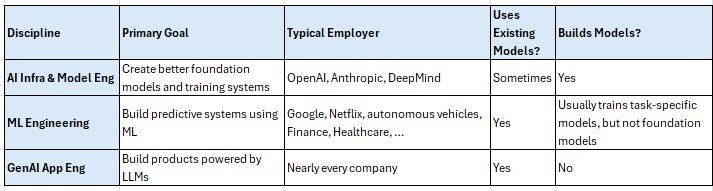
Note: the boundaries are starting to blur. Firms are increasingly hiring engineers who sit between Levels 2 and 3. These engineers might take an open-weight model (such as a Llama-family model or another foundation model), perform domain-specific post-training or fine-tuning, build a RAG pipeline, and then deploy an agentic application. They are not inventing new model architectures, but they are also doing more than calling API’s. This hybrid role is likely to become one of the fastest-growing AI engineering specializations over the next several years.
Positive Hiring Anecdote
A client called me a few weeks ago to discuss a need. This C-Suite executive had twice tried to build an application with his dev team with poor results. So, he downloaded Claude (he’s not technical) and built the application himself - with great success! His takeaway was NOT “fire all devs we can do this ourselves.” Rather, his conclusion was, “Wow, we can solve so much now – I need to hire 5 people!”
That’s Jevon’s Paradox in action! Also, companies investing most in AI are hiring most.
New Role Descriptors
AI is rearchitecting the organization: The Head of Claude Code Says Your Startup Needs These 5 Employee Archetypes: Prototyper, Builder, Sweeper, Grower, Maintainer.
Canaries Dashboard
Stanford conducted a detailed study of employment effects since the release of ChatGPT in November 2022. Key takeaway: “We are now transitioning out of this investment phase into a harvest phase where those earlier efforts begin to manifest as measurable output.” (Stanford Digital Economy Lab and ADP Research. "AI Economic Indicators: Canaries Dashboard." Accessed 7/30/26.)
Notable findings, none surprising:
Employment growth is slowest in the most AI-exposed occupations
Early-career workers show the strongest exposure-related divergence
Employment changes are concentrated in specific occupations
Occupations with heavy automation vs. augmentation usage show different trends
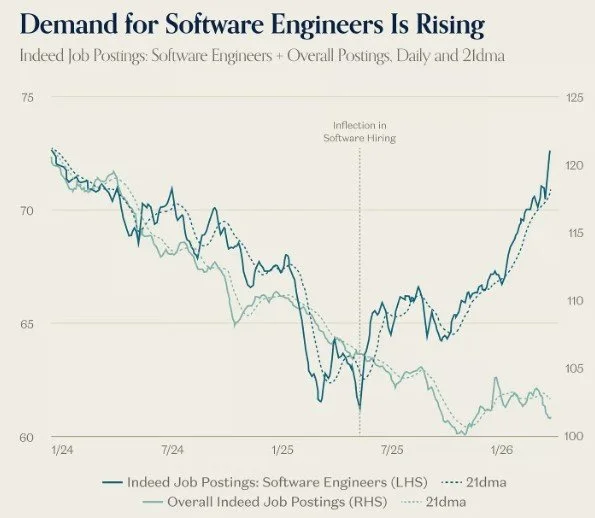
The new world favors experienced individuals who are highly productive with the new tools. New grads face a Catch-22. Note that demand for Software Engineers is sharply up over the past year:
Related, Dōmo arigatō, Mr. Roboto is an excellent and in depth article by Byron Gilliam that delves into these hiring trends and explores the cost of AI “workers” vs humans.
Current Priorities
Buy Side
Hiring remains robust. If you’re interested in pursuing Buy Side opportunities, please be in touch.
Sell Side
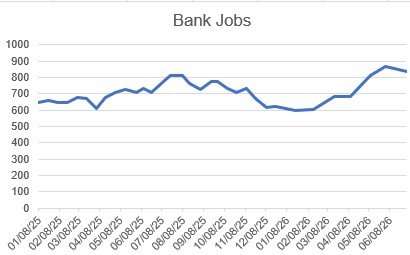
We are not active with Sell Side firms. Budgets preclude agency usage. Trend is up (with a bit of a summer dip). As expected, >50% of these postings are data/AI related.